
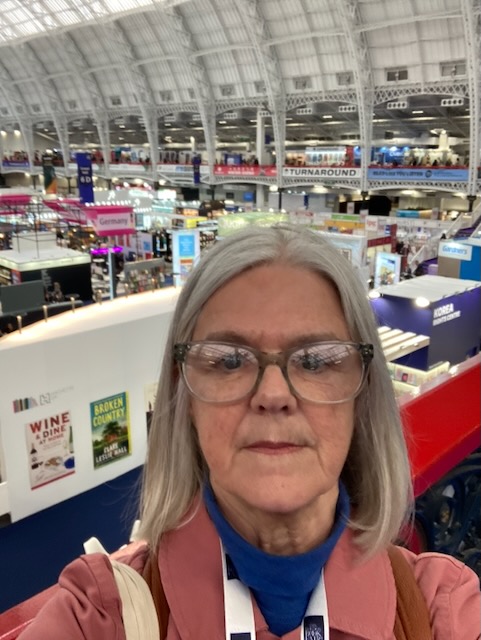
I decided to attend the London Book Fair this year because it felt like a necessary orientation: a chance to better understand the ecosystem I now find myself working within as an independent author. The opportunity for visibility, curated by the Alliance of Independent Authors under the banner of The Indie Author Lab, made it an obvious place to start.
Attending for all three days gave me a strong impression of this new arena. I am now in my fourth career, and while it echoes aspects of the previous three, this one feels the most challenging — not because of difficulty as such, but because of how much new learning it demands. With age, it is easy to lose sight of beginner’s mind. It is all too tempting to say well, it used to be… or nothing has changed. And yet something has — not least my willingness to stay curious rather than cynical about how the machinery works.
I couldn’t help drawing comparisons with my theatre experience. Being at the London Book Fair felt like being at a small‑scale theatre festival held within the orbit of the West End: the tiny inside the gigantic; chalk and cheese. Creative life sits awkwardly alongside the high‑end publicity machines, pre‑set meetings, and industry hype. It can feel far removed, with a great deal of lip service paid to “creativity” itself. But who am I to judge? These days it doesn’t feel quite as cut‑throat — perhaps because we are no longer that young, or that invested in winning.
For me, there alone and very much a small fish, the chance to meet people from the indie sector with whom I’ve only had virtual relationships was genuinely inspiring. I had forgotten the pleasure of learning something entirely new: the naïveté of being at the bottom of the pile, the rebellious energy that lives in niche corners, and the bubbles of specialness or delusion that form there — something I remember well from theatre.
The day‑long workshop I attended took place away from the hubbub of the fair, up the road at Kensington Town Hall. A formidable group of indie experts led tightly organised panels, supported by carefully facilitated group discussions. The atmosphere felt notably non‑hierarchical and distinctly feminine in tone. Long‑standing, successful self‑publishing authors were woven thoughtfully into a room of over a hundred delegates.
One of the most striking aspects was the way table discussions were managed: a feather was held — peace‑pipe fashion — to signal whose turn it was to speak. For me, a rather reticent newcomer, this was a gift. It levelled the room and gave me confidence; I spoke far more than I expected. Unsurprisingly, it seemed more challenging for those used to dominating conversations.
A highlight of the day was Joanna Penn’s presentation on the business side of self‑publishing. A self‑proclaimed introvert, she is also a natural performer. Years of creating and publishing books have given her a quiet authority that sits comfortably within a milieu where she is now one of the stalwarts. I first encountered her years ago, during a transitional period when I was balancing political responsibilities with an urge to publish Redhair and Daffodil Friend. I’ve been listening to her work for over four years now; she has been building this business for almost twenty. Her generosity and clarity were a real bonus.
Another unexpected pleasure was meeting the people behind the systems that actually produce my books — representatives from IngramSpark, Bookvault, and KDP, which I don’t currently use. Being able to ask practical questions face‑to‑face, and to meet the humans behind the paywalls and customer‑service structures, was both grounding and reassuring.
Other curiosities included the sheer number of Christian publishers, the scale of translation‑rights activity, and the wall‑to‑wall presence of names I felt I ought to know. Once again, this echoed my theatre experience: the companies and artists who loomed large in my own working life were, in the wider world, relatively small.
In writing this, I realise I’m circling questions of significance, visibility, and traction — and of what it means to stay the course. I’ve given up three times before, for all sorts of reasons. What this fourth iteration will bring, I don’t yet know. But I leave feeling more committed to staying visible — not loudly or relentlessly, but consistently — and to trusting that experience, held lightly, is no bad companion when beginning again.
Comments 2
fascinating insights, thank you.
I really appreciate participating in this experience through your vivid description. I relate to being a newcomer in this huge and mystifyingly word of publishing. I will now straighten my back a little. We small fish have a place in this ocean! Perhaps I will even brave a book fair.