
What’s in an event?
The Whissell and Williams Project
Last time I wrote I focussed on What’s in an Award? This post concerns another aspect of my creative practice: forming the event.
When I started touring my creative work in the early nineties it would take the form of a solo performance and a workshop. In today’s language that would be the event. For me, however, this would develop into something longer unfolding over a period of time. This It might become a residency or a course often leading to a separate event.
Then there were the events that I became part of as the work became marketized as part of other people’s or organisations’ events. Gradually, over time, the event became a marketing exercise in itself: a stall of leaflets, a performed extract advertising what you do, a slot in a mini festival. It was something you had to participate in in order to be seen or have a chance to be on a circuit. Sometimes it might even be a completely free offer to taste and see, often under the persuasive guise of a well-paid marketeer or event organiser’s suggestion – it will be good for your business, get you in the networks.
Then in the 2000s arts funding made circuit bookings a compulsory part of the application process and a condition of the route to a successful bid. Each application would require you to predict the outcome of the journey before you had even got your boots on.
Over the years, I saw this as a move away from independence and creative freedom towards a professionalisation, a kind of taming of the act of creativity, making it conform to more ‘trusted’ practice, often led by business and corporate interests. When I say corporate, I mean that in the sponsorship context, but also in the corporate processes larger arts organisations might adopt in order to compete.
If you believe in developing an event from your artistic methods and processes, you can’t really know the tangible outcomes in advance. But if you made the journey there, and the actual putting on of boots, part of the experience of the event, then I could buy that.
The event as an unfolding enquiry
I could manage the structure of an extended event:
- A show followed by a workshop unpacking the show.
- A workshop exploring the methods used to create the show.
- A workshop applying those methods.
- Rehearsal time developing and rehearsing a new show created by workshop participants.
- An event incorporating that showing.
- A further unpacking of the new work.
What I didn’t have, and couldn’t afford, was the infrastructure that would successfully make this model work. Neither could many of the organisations I worked with afford, or trust the model enough to give it ago.
So often it remained at the simpler format: do a show, do a workshop, follow up with a discussion.
Only within the academy could you really knuckle down with a group around practice and method. Even then, the work had to follow a particular prescriptive route, and you would be lucky to show your stimulus work other than through demonstration or at most through a short video clip.
There have, however, been three projects where I managed to defeat the system: one in schools, one culminating in a week’s performance run and complementary exhibition and website, and one within professional and academic contexts over several years.
The Whissell and Williams Project, The Last Women and Birnam Wood
Three very different projects but all examples of how, despite all the rules and regulations, funding limitations and gatekeeping methodology, one can maintain an artistic professional enquiry over time moving in and out of an event system, under the radar, so to speak.
The first is particularly relevant to my thinking now, when so much funding of events is geared towards children, families and communities. It also seems appropriate to revisit in November, a month in which remembrance is especially prominent.
The Whissell and Williams Project

Whissell and Williams
This project came out of an artistic collaboration with a trusted colleague developed over several years. That artistic trust was central to the enquiry.
It fused a methodology of working creatively with young people developed over decades inspired by amongst other methodologies, Theatre-in-Education practices I was familiar with along with our creative instinct to stretch and test those methods, though I wouldn’t say that was an explicit aim. It has emerged as I have understood my practice through different lens.
The additional risk and artistic learning concerned how far in role exploration could be taken. Educationally, we were exploring how close to a real experience of the Second World War Two homefront in Britain we could be take participants in order to encourage in-depth learning through emotional engagement.
The project grew out of a prolonged theatre company residency in a Coventry museum.
Funding came through a regular agreement between the theatre company and the museum over several years, additional project funding and the Renaissance in the Regions programme of the early 2000s.
It required the event managers to be experts in museum knowledge and practice but hands off in terms of artistic eventdevelopment. It also required healthy partnerships across the city with schools, other museums, community providers and the cathedral education department. These partnerships were also contributory but arms-length.
The theatre company led the project. Artistic processes took priority although this was largely unspoken. Museum and educational priorities provided the language through which the project was marketed and championed.
The creative context and project idea allowed the project to develop over five years, though this wasn’t known at the outset. There was enough trust and mutual respect between the main partners to allow the development to happen naturally.
We began with a pilot phase with the theatre company’s fledgling children’s performance group based at the museum. We worked with the children over weekends and school holidays. From this emerged a film Dugout! and a developed methodology an in-house schools 2-day exploration based at the museum. This was the second stage which was marked by the creation of a film The Whissell and Williams Homefront Training Camp.
The third phase culminated in a longer overnight residency at a scout camp with deeper immersion for participants and training in the in-role methods for partner organisations and for a new intake of actors. It was preceded by school visits in role, site-based activities in the city where the children experienced events such as a 1940s library session, a 1940s history lesson, a talk from the Provost of Coventry Cathedral and marching in units around the city as well as talks from elderly people who had lived through the war in Coventry.
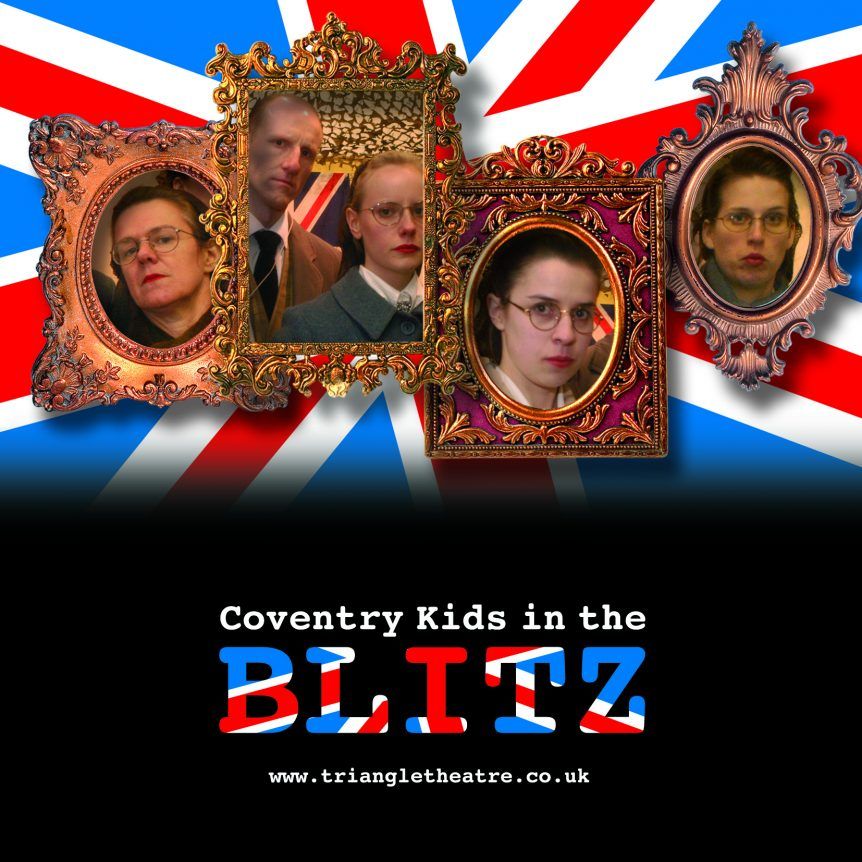
The final overnight immersion required participants to experience the whole evacuation process and be chosen by their countryside-based families. As performers we stayed in role for the entire process and only revealed our true identities in an evaluation sequence a while after the event. What followed was a 1940s style film screening of Coventry Kids in the Blitz and its various creative responses from participants spin-offs at a large theatre venue.

Note:archive website:https://triangletheatre.carranwaterfield.co.uk/
The fourth phase extended the training model. Newly trained actors worked with A Level Drama students preparing them to deliver the project to primary schools again at the scout camp and over a period of school visits before the final immersion. A professional film was made of this project, War is Over.
We made one final return to the scout camp for the fifth phase with the now older members of the fledgling children’s performance groups who had initiated the enquiry, this time exploring the Cold War. From this we made the experimental film The Wall.
A further publication phase brought the work together in a DVD resource bringing together the films from each phase, participant and partner reflections, research materials and evaluation.
Each phase had its own events and outcomes, but each also informed the next stage of the enquiry. The work was not simply a format repeated for successive groups. It was an artistic and educational investigation developing over time.

What remains of an event?
Beyond that, the work won a Best Educational Initiative award, travelled to Australia and Denmark. Subsequently it developed into an in-role teaching tool at Salford University for induction week in the 2010s. In fact, just the other day Mr Whissell led a lecture on power for students at the same university.
One of the participants in the fourth phase, Stacey Macdonald, recently contacted me. Now in her thirties, she had been talking with her children about her experience of the project after her eldest son began studying the Second World War at school.
She remembered the group walking through the woods near Meriden in 1940s clothing, accompanying younger children playing evacuees, complete with identification tags and rationed lunches.
She wrote,
‘I have not been able to stop thinking about it since, as it was an amazing experience, despite the cold snap of the season setting in.’
She described it as one of her fondest memories of studying drama, and of school generally. What interested me was not only that she remembered the experience after more than 20 years, but that it had resurfaced in conversation with her own children and their teachers. The event had not remained within the boundaries of its original program, its film screening, or its evaluation, it had travelled with a participant into another stage of her life. That was not an outcome I could have prescribed at the outset. Looking back, I am reminded of how possible it is to be in and not of a system retaining artistic freedom despite the challenges of funding, regulation, and institutional requirements. This project was not free of structures or organizational responsibilities; it depended on them. But the artistic enquiry was able to lead, and the Participating organizations had sufficient trust in the artists and their methods to allow that to happen. The experience was not designed simply to be fun. It asked something of those taking part, commitment, imagination, concentration, and a willingness to enter an unfamiliar world. It offered an encounter rather than a packaged entertainment.
In my next post, I’ll return to the present and reflect on what it means to form an event today. I’ll drawn on some recent encounters of my own, whilst looking at how cultural events are conceived, programmed and presented for public consumption. What happens to artistic enquiry and development when the event itself becomes the product?

Further reading and archival references
The Whissell and Williams Project and its associated films were documented in contemporary theatre criticism, museum reports, academic research and government publications. The following references offer different perspectives on the project’s development, recognition and continuing life.
The films, research materials and reflections from the project were brought together in Triangle’s Work in Times of War, a DVD-ROM resource documenting the development of the artistic and educational enquiry.
The DVD-ROM remains available through my website.
The project also received recognition at national government level. In an article entitled Cultural renaissance is already here for regional museums, published in Talking Point, Margaret Hodge, then Minister for Culture, singled out Coventry Kids in the Blitz as a “highly ambitious project” and an example of the quality of work supported through the government’s Renaissance in the Regions programme. The accompanying photograph credited Richard Talbot and me with conceiving the project.
- Naish, Jessica (2003). ‘Dugout!’ Total Theatre Magazine.
A contemporary account of the artistic methodology and the children’s involvement. Particularly relevant to your discussion of immersion, risk and artistic enquiry.
- Hodge, Margaret (2008). ‘Cultural renaissance is already here for regional museums.’ Talking Point, p. 11.
- University of Manchester. Performance, Learning & Heritage — Research Appendices.
Academic documentation of Triangle’s work at the Herbert, including Dugout!, Coventry Kids in the Blitz and War is Over. Also records the project’s awards.
- West Midlands Museums Hub (2006). Two-Year Review.
An official account of the development of immersive living-history work in Coventry, recognising Kids in the Blitz and the subsequent War is Over project.
- University of Bristol Theatre Collection. Triangle’s Work in Times of War — Archive catalogue.
A catalogue entry documenting the films associated with the project and the survival of the work within a specialist theatre archive.
- Richard Talbot. Whissell & Williams — Ludic Research.
- Waterfield, Carran (2011). ‘Report on Triangle’s Work in Times of War’,The PALATINE Collection, p. 37.
Find the report and downloadable PDF